04Spoken language in, written language out.
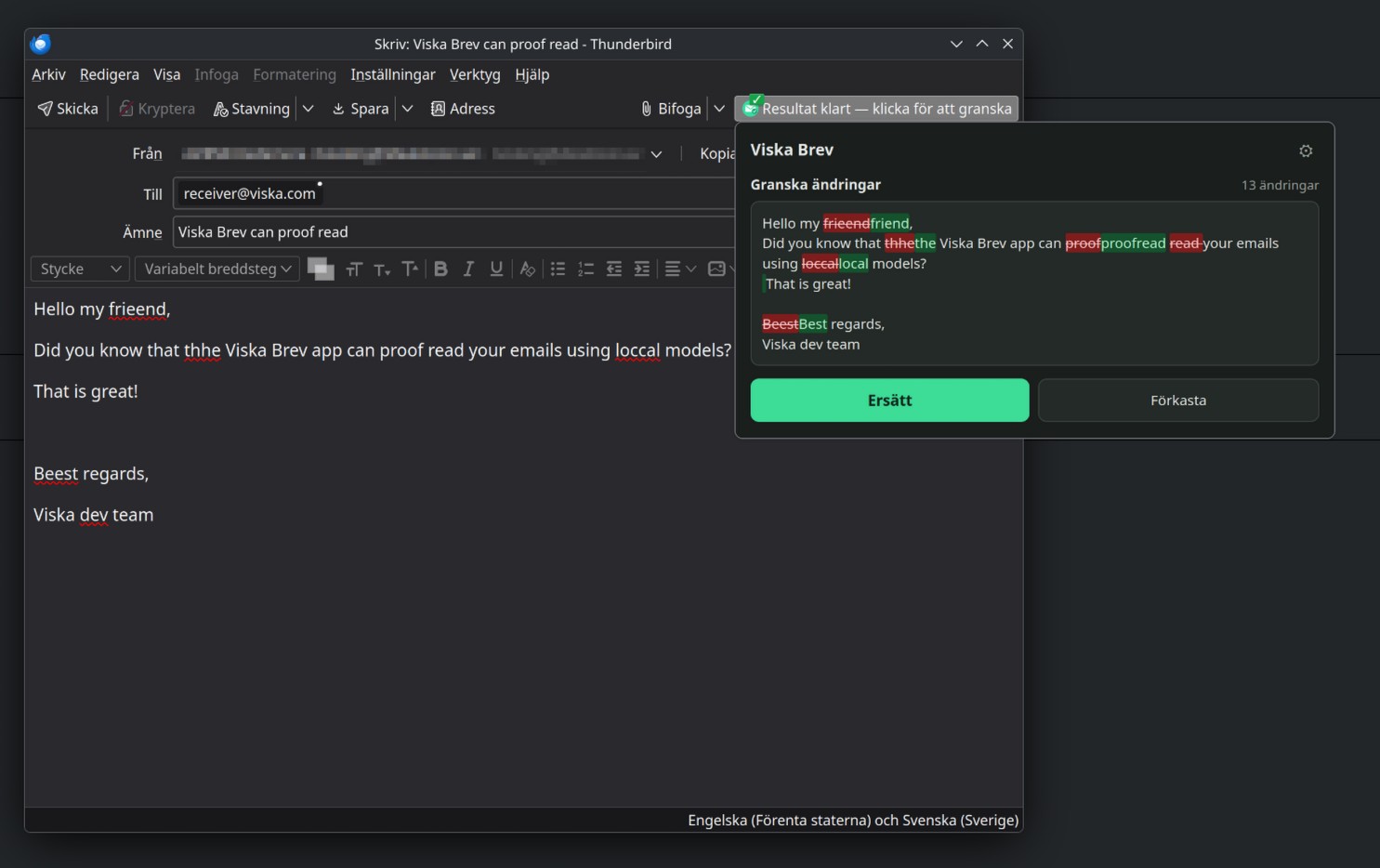
Speech is full of “um”, restarts and second thoughts. Turn on proofreading and every recording is cleaned up before it reaches the cursor — or keep it off and use the second gesture when a message matters.
What was said
um so I was thinking we could uh meet on Tuesday no Wednesday actually and go over the the budget before we send it to
Grammar
Um, so I was thinking we could, uh, meet on Tuesday—no, Wednesday, actually—and go over the budget before we send it to
Fixes spelling, punctuation and grammar. Keeps your words and your voice.
Intuitive
So I was thinking we could meet on Wednesday actually and go over the budget before we send it to
Also drops filler words, restarts and self-corrections, and finds the word you meant.
I’ve been testing cloud code from anthropic with the new opus model → I’ve been testing Claude Code from Anthropic with the new Opus model.
Real outputs from DeepSeek V4.1 Flash with Viska’s bundled prompts, 25 September 2026. When a name was misheard, Intuitive writes the one you meant if the context makes it clear, and otherwise leaves your words alone. A spoken question such as “can you explain what a vector database is” comes back corrected — “Can you explain what a vector database is?” — not answered.
Local or cloud — your call
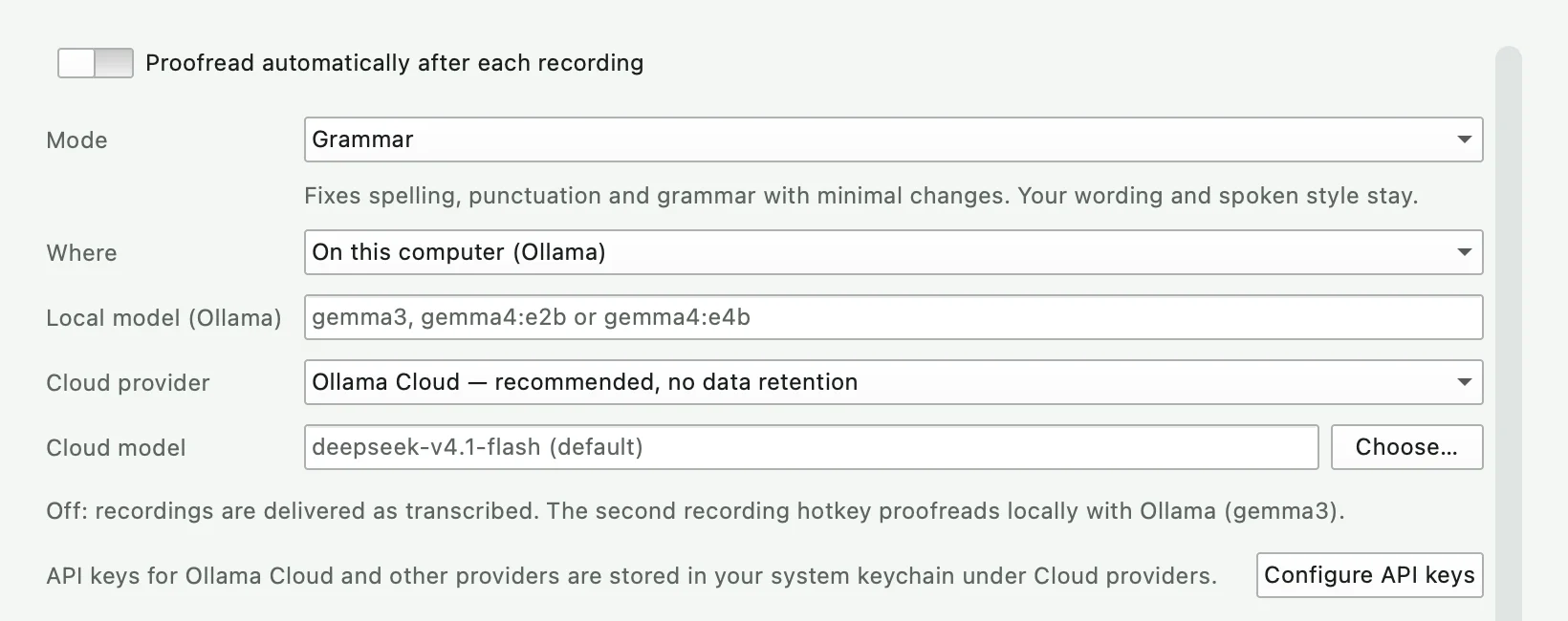
Proofreading runs on your computer through Ollama, or in the cloud with your own key. Nothing is sent anywhere until you choose a cloud provider.
Our cloud pick: Ollama Cloud
Ollama states that prompts and responses on its cloud are never logged or trained on, for every model it hosts (ollama.com/pricing). Viska defaults to DeepSeek V4.1 Flash there: capable enough to understand what you meant, answered in 0.3 to 0.9 seconds per request in our tests on 25 September 2026, and costs $0.30 per million input tokens and $1.20 per million output tokens at peak rates — a typical dictation is a fraction of a cent.
Using OpenRouter instead?
Turn on Zero Data Retention in your OpenRouter privacy settings. OpenRouter then routes your requests only to providers that keep nothing, and OpenRouter itself does not retain prompts unless you opt in to logging. OpenAI and Anthropic are available too, under their own terms.
Checked 25 September 2026.
Does Viska work offline?
Yes. Once a speech model is downloaded, dictation runs entirely on your computer with no internet connection. Cloud engines and cloud proofreading are optional and only used when you choose them.
Does my voice leave my computer?
Not by default. Viska transcribes on your own computer and keeps audio in memory. Your voice leaves the computer only if you choose it. With host mode, audio goes only to your own host over your private Tailscale network. If you pick a cloud speech engine such as Groq or OpenAI, it goes to that provider. Cloud proofreading, if you turn it on, sends the transcribed text, not the audio.
Is it really free?
Yes. Viska is open source under the GPL-3.0 licence: no account, no subscription, no word limit. If you add a cloud provider, that provider bills you directly for what you use, and the app can track the estimated cost.
Is Viska a private alternative to Wispr Flow?
For dictation on a computer, yes. Both type where your cursor is. Wispr Flow transcribes in the cloud, and its documentation says data is processed and stored in the United States; Viska transcribes on your own machine by default, is free and open source, needs no account, and can share your own GPU with your laptop and Android phone over Tailscale. Wispr Flow has iPhone and Android apps, more than 100 languages and a personal dictionary that learns names; Viska runs on Linux too. Read the full comparison.
Can I use Viska for voice typing in ChatGPT, Claude or my code editor?
Yes. Viska types into whatever app has the cursor, so it works for AI prompts in ChatGPT, Claude or Gemini, for email and chat, for documents and for code editors and terminals. In a terminal, paste with CtrlShiftV if typing is blocked.
Which speech recognition does Viska use?
OpenAI’s open Whisper models, run locally through whisper.cpp or faster-whisper, and KB-Whisper from the National Library of Sweden for Swedish. You can also plug in cloud engines such as Groq, Deepgram or ElevenLabs with your own key.
How accurate is it?
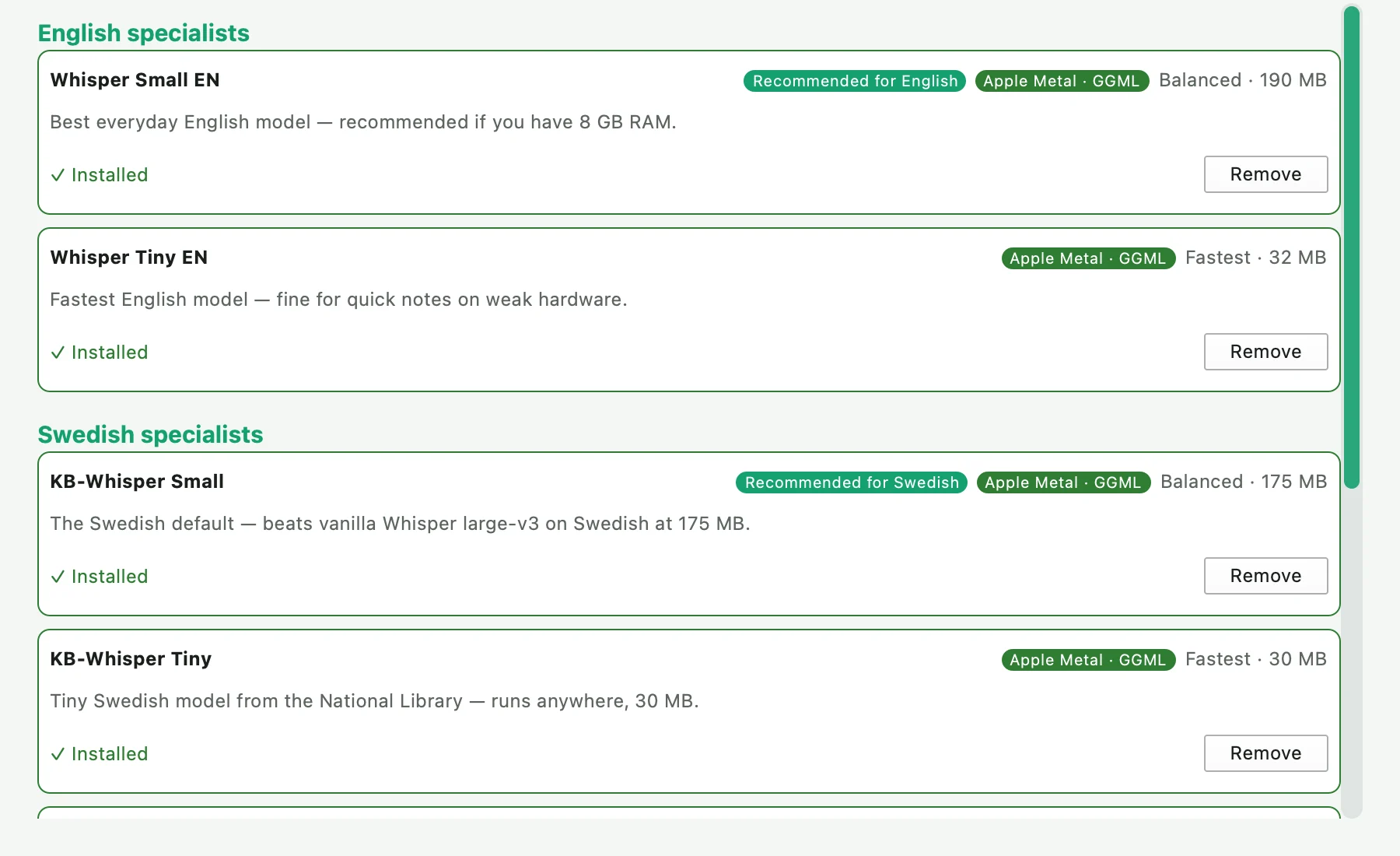
Viska uses OpenAI’s Whisper models and, for Swedish, KB-Whisper. Larger models are more accurate and slower; the Models window labels each one by speed and size so you can choose for your computer. Proofreading can then fix what was misheard.
Why does Windows warn me when I open the installer?
The Windows preview is not yet signed with a Microsoft code-signing certificate, so SmartScreen asks you to confirm. The Windows guide shows how to do that safely, and every download has a SHA-256 checksum you can verify. The Mac app is signed and notarised by Apple and opens normally; see the macOS guide for the permissions it needs.
Can I dictate on my phone?
On Android, yes, with Viska Voice: a voice keyboard that sends your speech over Tailscale to your own computer running Viska in host mode. There is no iPhone app, and nothing is transcribed by a cloud service.
Can one computer with a GPU serve my other devices?
Yes. Run Viska 0.7.1 in host mode, publish it with Tailscale, and pair your other computers or your Android phone. How host mode works.
Does it work on Wayland?
Yes. On KDE Plasma and GNOME 48+ the global shortcuts use the XDG GlobalShortcuts portal; Hyprland uses xdg-desktop-portal-hyprland. On older desktops, bind a system shortcut to viska --toggle.